
When the System and Future Drift Apart
On the quiet tension between technological advancement and the world we’ve built.

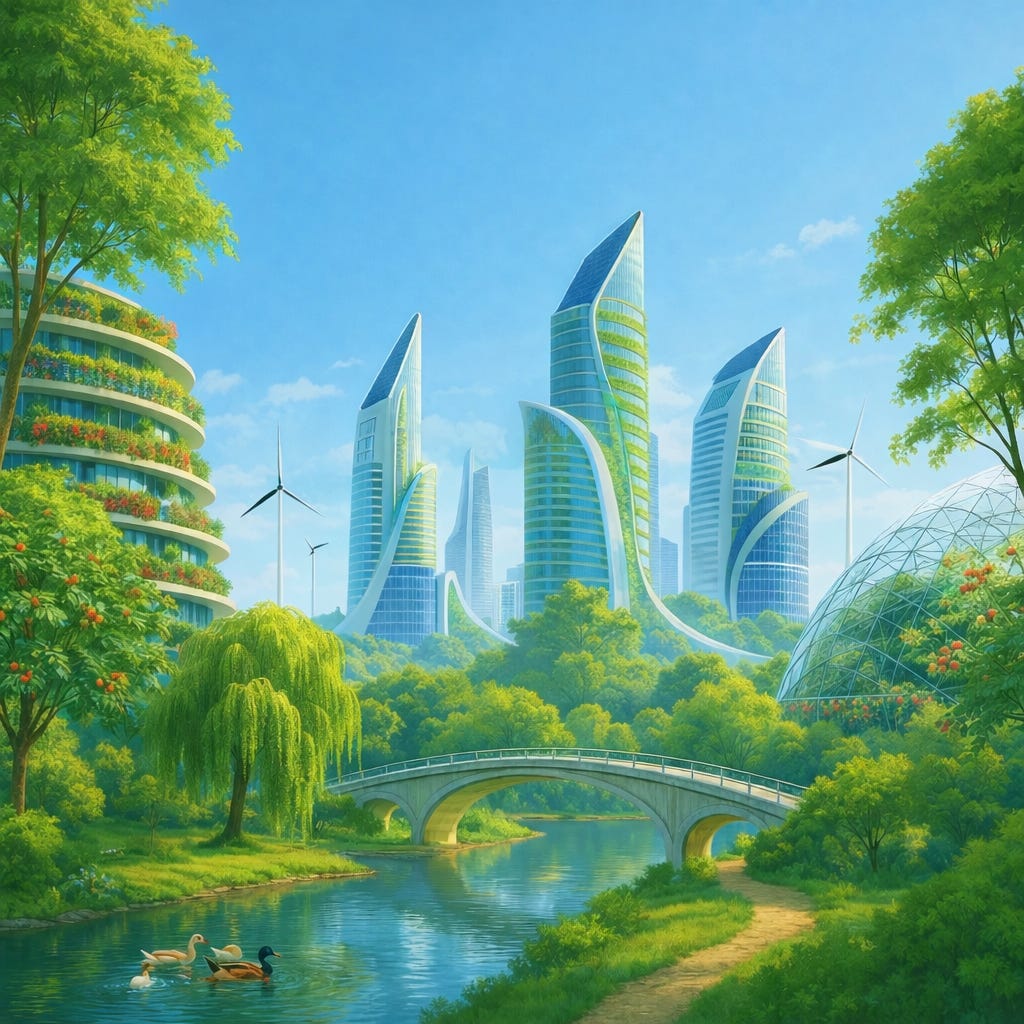
Every so often in history, the world shifts quietly beneath our feet. Not with a dramatic crash, but with a subtle change in rhythm – a new tempo to life that many people sense long before they understand it. Today, that feeling sits beneath our conversations about technological advancement: a soft tremor, an intuition that something deeper is changing than the headlines suggest.
Yet amid the interviews, the debates, the anxious commentary, one question is almost never asked: What if the system we’re defending was simply built for a world that no longer exists?
The Mirror, Not the Threat
There’s a growing conversation about AI, automation and robotics replacing human jobs. We hear it in interviews, podcasts, panel discussions – a steady, anxious hum beneath the surface of public life. And yet something always strikes me: how rarely anyone questions the socio-economic system itself.
The focus tends to fall on the technology, as though it’s the problem rather than the mirror. The truth is uncomfortable to sit with, but important to name: AI didn’t create this tension. It simply reveals the limits of a system that was never designed for a world where machines can do most of the work.
There are, of course, valid concerns about the misuse of AI – and technology more broadly. But these concerns are not rooted in the technology itself. Instead, they point to flaws in the structural implementation and the social value systems inherent to our current socio-economic paradigm.
Another concern often raised is AI’s current environmental footprint. But the sustainability question isn’t really about AI in isolation. It’s about how we choose to build, power, and use it within the systems we already have.
Used thoughtfully, AI also holds the potential to reduce environmental impact in a number of ways – from optimising energy grids and reducing waste in manufacturing, to supporting precision agriculture, improving climate modelling, and monitoring ecosystems and resource use in real time.
Seen this way, many criticisms of AI’s environmental impact are less about the technology itself, and more about the sustainability profile of the system it’s embedded within.
Work, Worth and Human Potential
We are naturally evolving out of the need to “work for a living”, yet we’re still living inside a framework that insists we must. Many thinkers, including Geoffrey Hinton, suggest that AI, automation and robotics will eventually replace most if not all human labour. I tend to agree.
And in a sensible world, that could be a very good thing.
The liberation of human time, creativity and imagination should be a quiet triumph, not a crisis – but only if the system and our values are aligned with that possibility. At the moment, they’re not. We’re still operating inside a model where income is tied to employment, where competition is tied to survival, and where a person’s worth is measured by their productivity – at least as defined by the socio-economic system we live within, rather than by the value of what they actually contribute.
Stephen Hawking touched on this tension:
“If machines produce everything we need, the outcome will depend on how things are distributed. Everyone can enjoy a life of luxurious leisure if the machine-produced wealth is shared, or most people can end up miserably poor if the machine-owners successfully lobby against wealth redistribution. So far, the trend seems to be toward the second option, with technology driving ever-increasing inequality.”
And it’s worth noting something simple: many people wouldn’t consider the writing I’m doing here to be real “work”, yet if I ever get paid for it, or receive a publishing deal, then it suddenly transforms into being perceived as ‘earning a living’ – as legitimate work. The activity is the same – only the economic framing changes. The same is true of charity work that transforms lives, or even the volunteers who help preserve my local park so the public can enjoy it – essential contributions that only become “work” in the public imagination when money changes hands.
Our understanding of work has never been purely about the activity itself, but the structure wrapped around it.
The Fear That We Will Do Nothing
Another familiar concern often appears at this point: “If people don’t have to work for a living, won’t they just become lazy or unproductive?” But that fear misunderstands how responsive human nature is to the conditions we live in. When people are freed from constant survival pressure, their better qualities tend to rise, not fall. Security doesn’t dull curiosity – it nourishes it. Throughout history, many of our most meaningful contributions have come from individuals who had the time and stability to explore, create, experiment and learn for the sake of meaning rather than necessity. Humans are not naturally idle; we are naturally driven when our energy isn’t consumed by anxiety and stress from external pressures. When survival is no longer the priority, purpose becomes the motivation – and purpose is a far stronger force than fear.
When Old Rules Break
When AI, automation and robotics break the old rules, our instinct is to blame the technology rather than the rules themselves. The system we were all born into gets defended as if our lives depend on it, rather than acknowledged for what it is: something that may no longer serve us well – and may no longer be socially or ecologically sustainable. And if we stubbornly refuse to evolve beyond it, the result is likely to be even greater inequality and a continued decline in human wellbeing.
This isn’t because all people in positions of power are villains, but because they’ve invested so deeply – psychologically and ideologically – in the idea that this system is the only viable way. When raised within an existing structure, it can feel like the only possible reality.
The Futures We’ve Ignored
Socio-economic systems are not permanent. They change when their assumptions no longer match the world they’re meant to organise. And we are approaching that moment. In the not-too-distant future, the real challenge won’t be AI and automated technology “taking jobs” – it will be deciding how to distribute resources fairly in a world where labour is no longer the gateway to survival.
Of course, one response would be to keep creating more and more unnecessary jobs, simply to preserve a system that has come to depend on them. But there are limits to how far that approach can stretch before its contradictions become clear. And it’s worth pausing to ask whether this is really how a thoughtful society would choose to respond – by inventing work for its own sake, rather than re-examining the assumptions the system is built upon.
Futurists, designers and social engineers have been pointing toward this for decades – imagining systems where technology supports human wellbeing; where access to resources isn’t dependent on income; where abundance is shared rather than concentrated in a few hands.
Some of these visions draw inspiration from design principles found in nature itself. Approaches such as permaculture remind us that natural systems waste nothing – every output becomes an input somewhere else.
Similar thinking appears in sustainable, closed-loop food systems like aquaponics and vertical farming, where efficiency, resilience, and regeneration replace extraction and depletion. These are not abstract ideals, but practical demonstrations of how human design can work with nature rather than against it.
Alongside this sits a broader re-imagining of how we organise resources and production. A world powered largely by renewable energy; one that moves beyond artificial scarcity and planned obsolescence; one that questions why waste – so often re-framed as “growth’ – is designed into many of the systems we depend on. In such a context, automation and AI could be used to manage production, inventory, and distribution with far greater precision than we currently achieve – not to displace human value, but to remove the need for vast amounts of repetitive, unnecessary labour.
At the heart of many of these proposals is a simple shift in emphasis: treating the planet’s resources as a shared inheritance, and addressing social and environmental challenges through evidence, experimentation, and learning – rather than short-term political advantage or financial gain. It’s not about replacing one rigid ideology with another, but about designing systems that are flexible, adaptive, and grounded in what actually works.
In quieter corners, away from headlines and mainstream political discussions, there are already people experimenting – not with perfect answers, but with new ways of organising care, resources and cooperation that place human and ecological wellbeing at the centre. Some of this thinking draws on systems theory, systems ecology and cybernetics, exploring the idea of transitional parallel economies based on organised cooperation rather than competition. This is a direction I may return to in a future essay, with more detail.
“You never change things by fighting the existing reality. To change something, build a new model that makes the existing model obsolete.”
– Buckminster Fuller
These ideas represent only a small sample of the thinking that already exists – often quietly, often at the margins – about how a society might be designed to support human potential rather than constrain it.
But these ideas have often been dismissed as unrealistic or utopian.
And in political arenas, where the framing is outdated and reductionist, such ideas tend to be conflated with proposed socio-economic models like socialism or communism – as if those are the only alternative options we’re capable of coming up with. This kind of narrowing can limit the conversation, keeping us all in a box that doesn’t need to exist at all.
A Transition Worth Planning For
My concern is that the sensible, out-of-the-box thinking offered by futurists and forward-thinking engineers and designers will only be taken seriously when the current system has been stretched to breaking point – when the patches no longer hold and the contradictions become impossible to ignore. I hope we don’t wait that long. A planned transition would be kinder, more stable and far less painful. But whether we plan for it or not, the tension will continue to rise.
A Gentle Invitation Forward
Technological advancement is not the force pushing us toward collapse – it’s the spotlight illuminating the gap between who we are and who we could be. If there’s something to learn from this moment, perhaps it’s this: the systems we build are meant to serve us, not the other way around. And when they stop doing that, we have both the opportunity – and the responsibility – to imagine something better.
And maybe that is the quiet invitation of this era: to loosen our grip on the familiar, to look gently at what no longer serves us, and to dare to envision a world where human wellbeing is not an afterthought, but the organising principle. A world shaped less by fear and scarcity, and more by possibility, creativity and care.
If this resonated with you, you’re welcome to continue this journey with me. 🌿
This is a deeply engaging piece, and I find myself strongly aligned with your perspective.
In particular, the passage distinguishing “work” from “hobby” felt almost like art to me. And the invitation to think together is something I find impossible not to resonate with.
If I may add one thought, very cautiously: there is one person in my life whom I would, honestly, describe as lazy. But he was not born that way. Over time, childhood trauma and repeated misfortune accumulated, and eventually he stopped leaving his home altogether, even refusing therapy or counseling.
Watching this up close has made me a little more careful with the idea that humans are never lazy by nature. Once inertia hardens into habit, escaping it can require a level of willpower comparable to breaking an addiction—sometimes even more. And I’m not convinced that such strength is common.
For that reason, while I agree that automation is an unavoidable trajectory, I also believe we need to diversify human desire away from money as a single axis of value. Modern society makes a structural mistake by measuring human worth—and recognition—almost exclusively through financial success.
If we could find ways to guide or satisfy our need for recognition through means other than money, I think we would move closer to a healthier society.
Interestingly, even the isolated person I mentioned seems to seek recognition and connection through the internet, using it as a way to engage with others.
I enjoy your work and this did not disappoint!! Bravo!! Thanks for sharing!! :)